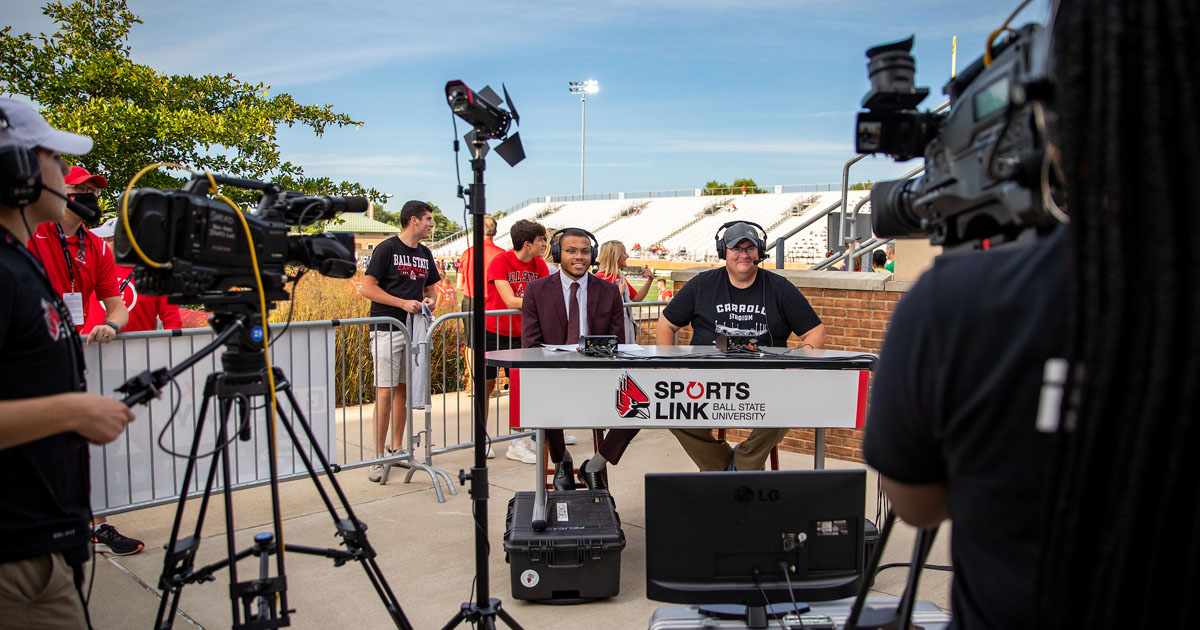
I have lost count of the campus control rooms I have walked through. They share a particular feel. A little too warm. A rack fan somewhere that should have been replaced two seasons ago. A schedule taped to the wall with volleyball, soccer, and a wrestling dual nobody outside the building will watch. And a nineteen-year-old on replay who is about to be better at this than half the people I have met in the field.
Something is coming for those rooms. It is arriving through a door nobody in our industry watches — the legal one — and I do not think we are talking about it in the right terms yet.
The short version of a very long legal story
College sports has a salary cap now. Schools pay athletes directly. There is an enforcement body checking that endorsement deals are real endorsements and not payments wearing a costume. Congress is busy writing a version of all this into federal law, with numbers considerably larger than what schools are working with today.
I will leave the case names and the section numbers to the lawyers. What matters for us is simpler. An athletic department that used to have a budget now has a payroll.
Payroll behaves differently than budget. Payroll is contractual. It is competitive. It is public enough that a rival can read it. And it does not flex when the fiscal year gets tight.
Something else has to flex. In my experience, the thing that flexes is whatever line item looks the most like overhead. Which brings us back to that warm room with the bad fan.
The reflex will be wrong
Here is what I expect the reflex to be. Facilities gets a number. The number is smaller. Refresh cycles stretch from five years to seven, then to whenever it fails. Two full-time operator positions become one, backfilled with students. The Tuesday night soccer stream drops to a single automated camera and a scoreboard graphic, and everyone agrees it is fine because the rights obligation is technically satisfied.
I think that reflex misreads the moment badly, and here is why.
The national rights are largely spoken for. The big packages are signed, the playoff is committed for years, and the legislation working its way through Washington would freeze conference membership in place — which quietly ends the realignment auction that drove the last three negotiations. If that holds, the growth is not coming from the top of the market.
Cutting it right now is selling the one asset with room to appreciate.
The campus feed is the one piece of inventory a school still fully controls. It is the only place left where the upside belongs to the institution rather than to whoever signed the conference deal. Cutting it right now is selling the one asset with room to appreciate.
Activation is a production brief
This is the part I find genuinely interesting, and it is where I will get speculative.
When enforcement rejected a batch of athlete endorsement deals this spring, the reasoning came down to a distinction that should sound familiar to anyone who has ever delivered against a contract. The deals were rejected in part because they parked the athletes’ likeness rights for later use without actually doing anything with them. Somebody used the word warehousing. What was missing was activation — real, documented, produced use.
Read that again as an operator instead of as a lawyer. A rule now exists that says the money is only legitimate if content actually got made.
Who makes it? Not the network. The network is there for three hours on a Saturday. It is the campus shop. The same crew doing the Tuesday soccer match is suddenly the entity producing the evidence that a commercial arrangement was real. Shoots, features, social cutdowns, sponsor reads, appearances captured and logged.
That is not a cost center. That is a compliance function with cameras, and it is attached to money that has to move whether anybody enjoys the process or not.
The as-run log grows up
Follow that thread one more step and you land somewhere our industry is unusually well prepared for, though we rarely get credit for it.
We have kept as-run logs forever. We know what aired, when, for how long, and who approved it. We built that discipline for traffic and for advertisers and we treat it as plumbing.
In a world where an athlete’s appearance in a piece of content is the thing that makes a payment defensible, that plumbing becomes a financial record. Metadata stops being a nice-to-have for the archive and starts being the artifact somebody points at in an arbitration. Which athlete, which asset, which platform, which date, delivered by whom.
I would bet on that becoming a real product category inside three years. Not a glamorous one. Nobody wins an award for airtight logging. But if I ran a campus operation right now, I would be getting my asset management and my rights metadata in order well before I worried about the next camera refresh.
What actually worries me
I wrote recently about what the tape-to-file transition taught me. The efficiency was real. It also quietly deleted a quality check nobody had ever bothered to write down, and we did not notice until we needed it.
Here is my version of that question for this transition.
The low-value inventory is exactly where automation lands first. Olympic sports, midweek, small crowds, obligation broadcasts. Fixed cameras, automated switching, AI-assisted graphics and highlights. On the spreadsheet it is obvious. The audience will not notice. Honestly, the audience may not exist.
But ask the other question. What else was that step quietly doing?
That Tuesday volleyball match is where a student learns that the replay operator and the director have to breathe together. It is where somebody discovers they are calm when a camera drops in the third set. It is where the person who will run a truck at a Super Bowl in 2041 finds out they love this. Nobody has ever put a line item on it, because it has always been a free byproduct of an obligation we had to fulfill anyway.
Automate the obligation and the byproduct goes with it. Campus broadcast is the closest thing live production has to a farm system, and it is about to get optimized by people who are looking at a payroll problem and have no reason to know that.
I am not arguing against automation. The stones are new, they always are. I am arguing that somebody in the room should be able to name what we are trading, out loud, before the trade is made.
Automate the obligation and the byproduct goes with it
Where I would place the bet
My read is that campus broadcast centers do not shrink over the next five years. They change jobs.
They stop being a fulfillment operation for a rights obligation and become the production arm of an athletic department that now has commercial obligations to its own athletes, a retention problem, a recruiting pitch, and a compliance file to keep. The schools that see that early will staff up while their peers are cutting, and they will look prescient in about four years.
The ones that treat the control room as overhead will save some money this year.
I have been wrong before. But I have watched this pattern enough times to know how it usually goes. The room with the bad fan is rarely the problem. It is usually the answer nobody has looked at yet.


Leave a Reply