Every spring, for most of the history of television, the same ritual played out. Networks would sell the bulk of a year’s ad inventory months before a single one of next season’s shows had aired — locking in prices and audience guarantees against a forecast of what people would want to watch, a year from now, in a market that hadn’t happened yet. It was called the upfront, and for decades it worked, because the pace of change was slow enough that a twelve-month bet was a reasonable bet.
It isn’t anymore. Streaming rewired the buy toward real-time and programmatic — inventory priced and placed against what’s actually happening, not what was projected to happen a year out. The upfront hasn’t disappeared, but it’s been shrinking against the thing that replaced it for a simple reason: nobody wants to lock in a year-long forecast in a market that reinvents itself every quarter.
Hold that thought, because portfolio leaders are about to relearn this the hard way, and the stakes are their entire budget.
The annual plan is written for a market that already changed
Portfolio strategy formulation is, by design, an episodic exercise — typically annual, often taking six to nine months to run from kickoff to funded plan. An organization starts the process in the spring for a fiscal year that begins the following January. That cadence was fine when the underlying technology moved at the pace of a product roadmap. It is not fine when the underlying technology — AI capability, specifically — can make a funded bet obsolete before the budget is even approved.
Three ways the annual bet goes wrong
Run the annual cycle against AI-era change and it fails in three specific, structural ways, not just “slowly.” You fund technology that’s commoditized or obsolete by the time the check clears. You chase analysis paralysis — a demand for a clean five-year ROI number that AI investment, with its high upfront uncertainty and asymmetric upside, simply can’t produce — and in the delay, you miss the market window entirely. And you lock capital into a rigid roadmap while the talent, infrastructure, and compute you actually need shift and get contested in real time, starving the initiatives that most need to move.
What replaces the annual plan
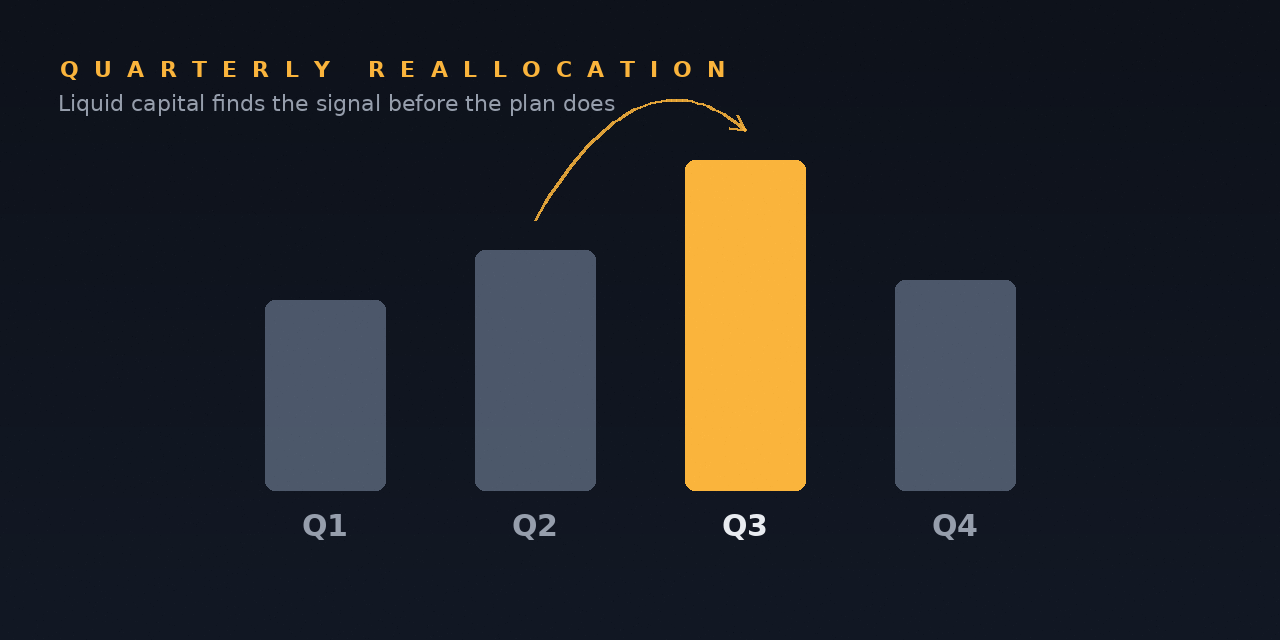
None of this means abandoning discipline — it means changing what discipline looks like. Treat the budget as a dynamic instrument with quarterly reallocation built in, not an annual document you defend. Borrow the venture model: place several smaller bets, expect some to fail fast, and double down on the ones showing signal — rather than making one large bet and hoping the forecast holds. Prioritize speed of deployment and real user data over a perfect launch, because in a winner-take-most dynamic, the org that gets there first compounds an advantage the annual planner never sees coming. And keep a liquid reserve on hand specifically so you can move on an opportunity or a threat the moment it appears, instead of waiting for the next planning cycle to notice it happened.
The horizon model needs the same update. AI collapses the cost of exploring — a Horizon 3 probe that used to take a quarter can now be validated in weeks — which means promising bets move toward the core faster, and marginal core products need to be retired faster to free the budget for what’s arriving behind them. A portfolio that still moves at the old horizon speed isn’t being careful. It’s being lapped.
So let’s drop a waypoint: the annual plan was never really about the year. It was about buying certainty in a market that could still afford to hold still. That market is gone. Plan for the ability to change your mind quickly, not for the illusion that you won’t need to.


Leave a Reply