The control room can see everything. Every camera, every graphic, every replay, every channel on the board. What it can’t see is the camera person’s feet, the temperature in the room, or the obstacles emerging.
The person on the set can see the studio audience, the interview guest and the studio crew. What they can’t see is what the director is planning two segments from now.
Between those two rooms stands one person with a headset on one ear: the floor manager. They have a hand signal for “wrap,” another for “you’re live in five,” and a flat palm for “hold.” I’ve watched a good one turn forty words of director chatter into a single gesture the talent never had to think about. I’ve also watched a night where nobody was standing there, and I can still tell you exactly how it felt.
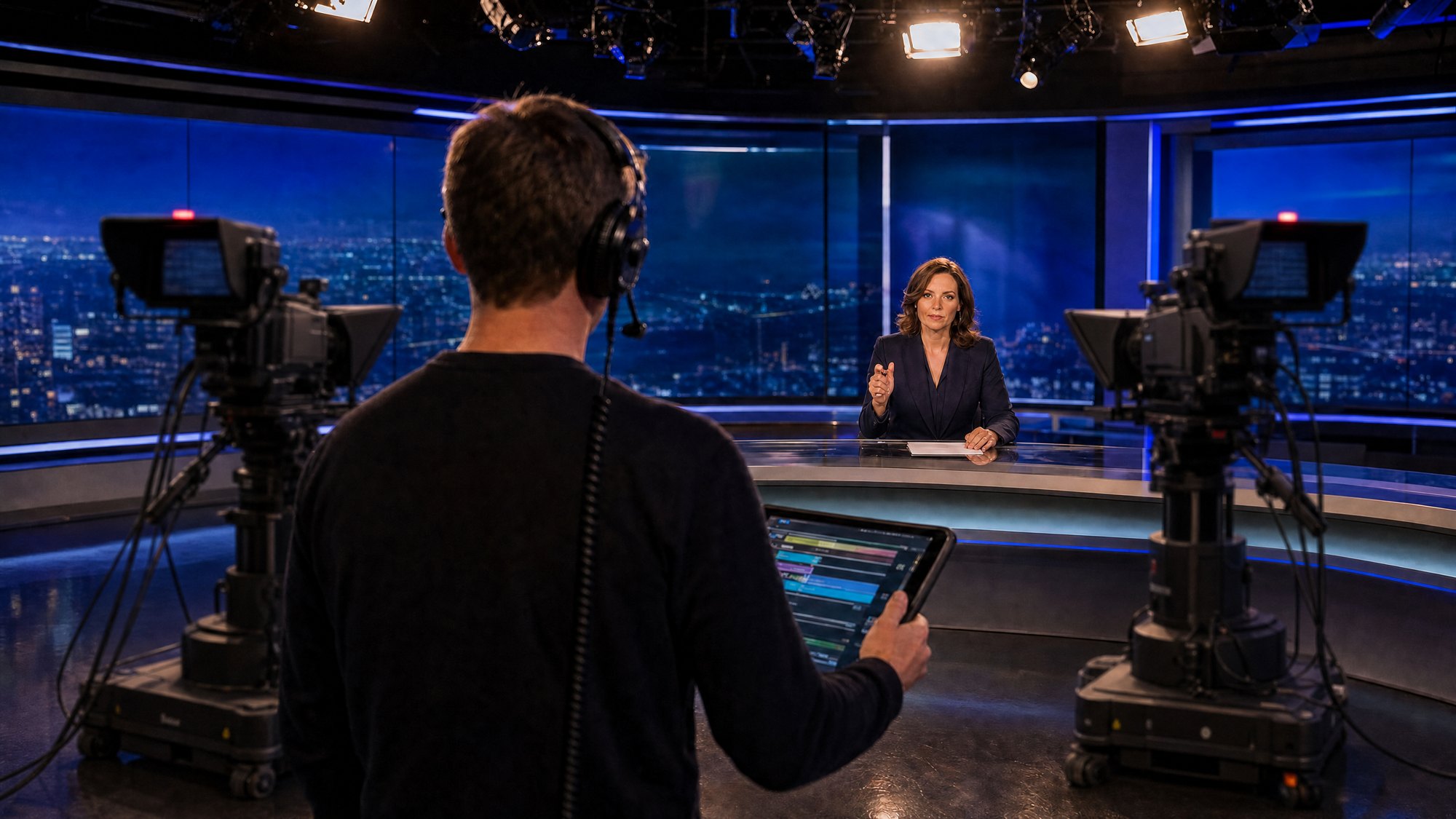
Two rooms, two views of the same show’s activity
Neither room is wrong. That’s what makes the gap hard to see. The control room has the complete picture of the signal. The set has the complete picture of the human. Each is confident, each is missing half the view, and each assumes the other half is being handled.
Product teams have the same architecture. The people who build can see the system. The people who face the customer can see the person. Everybody is working hard, and the show still drifts, because the information that matters most lives in the space between the rooms.
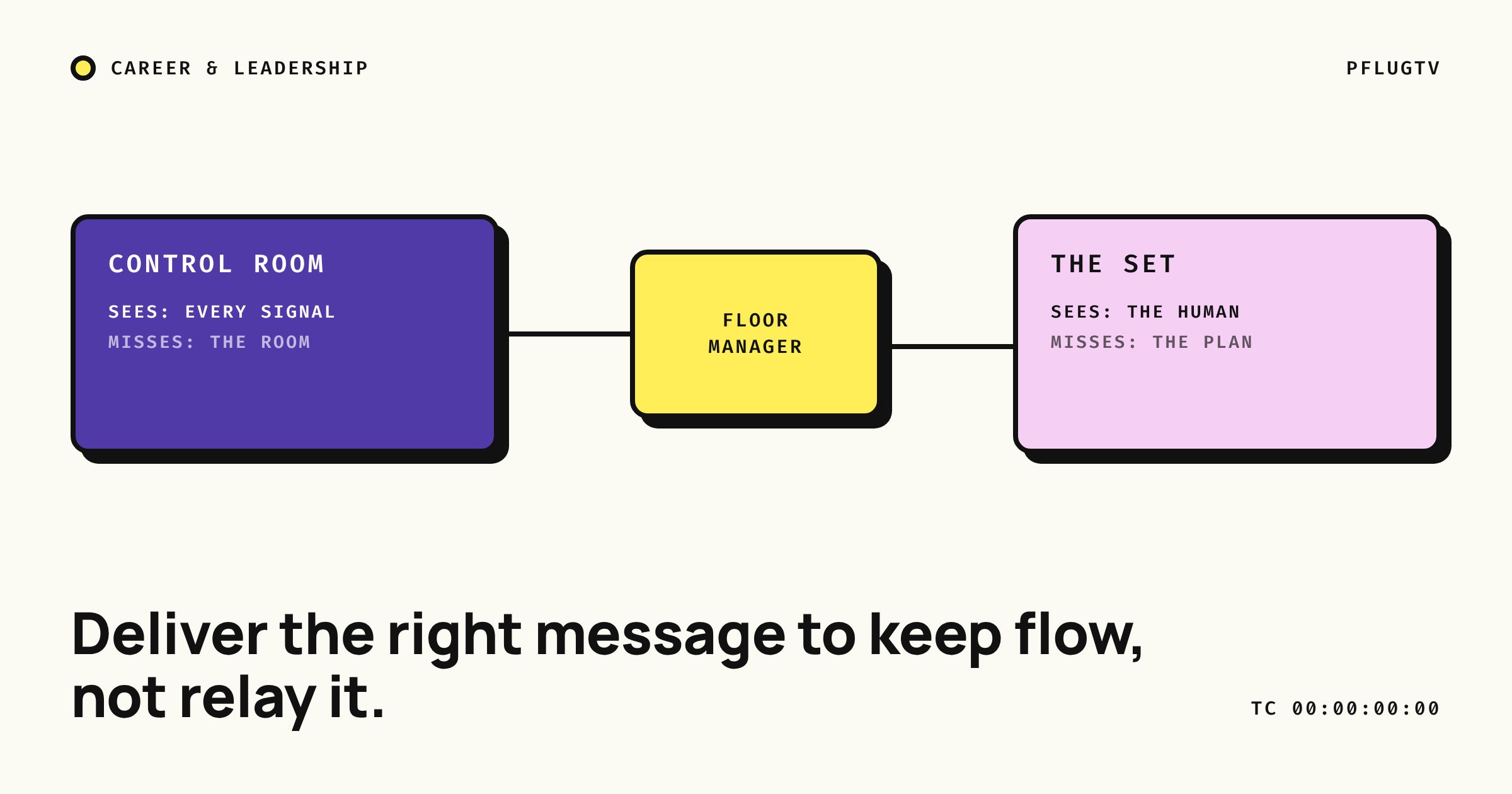
The job is to deliver the right message to keep flow, not relay it
A bad floor manager repeats what’s in their ear. “The director says there’s a change, something about the rundown, and they might go to the other camera, and—” By then the moment is gone.
A good one decides what the talent actually needs, and delivers only that. One signal. One word. Often just eye contact and a nod. The skill isn’t hearing more. It’s knowing what to leave out so the person on camera can stay in the moment.
That is a compression job, and it takes real judgment about both rooms. You have to understand the director’s intent well enough to drop everything that isn’t intent, and the talent well enough to know what they can absorb without losing their footing.
Trust is built in the small cues
Talent follows a hand signal without looking twice because it has been right a hundred times. Nobody announces that trust. It accumulates in small moments where the signal said “you’ve got ten seconds” and there were, in fact, ten seconds.
The same is true in a product org. A person who stands between engineering and the customer, or between strategy and the team, earns the right to compress by being accurate when it was inconvenient. Lose that once, and every future cue gets second-guessed, and the whole show slows down.
Hold that thought, because this is exactly where a lot of teams are about to make a very expensive assumption.
A summary is not a signal
The pitch sounds irresistible. Feed the model the customer calls, the support tickets, the survey comments, the analytics, the sales notes, the competitor website and teardown. Let it consume and process everything, summarize it, and hand the team a product. All the inputs, none of the meetings.
And it will produce something. That’s the problem. A summary is a shorter copy of everything that went in. It is a relay, and it’s a fast and fluent one. But a floor manager is not a relay. A floor manager makes a judgment about what matters right now to this person, in this moment, with these stakes. The summary has no stake in the show. It can tell you what forty customers said. It can’t tell you which three of them were describing the real problem and which thirty-seven were describing the symptom they happened to have words for. What it often can’t do, is understand what is in between, not explicit, or about to happen next.
Teams that treat summarization as understanding are skipping the one step that was never about processing power: deciding what the input means.
The cheap-output paradox
Here’s what I keep watching happen. When building products was expensive, the cost itself was a filter. Every feature had to survive a hard conversation, because someone had to staff it, schedule it, and defend it. Most bad ideas died in that conversation, quietly, and nobody thanked the conversation for it.
AI removes the cost and keeps the temptation. Now every idea is a prototype by lunch. Every stakeholder request can be a feature by Friday. Output is nearly free, so the team produces more of it, and the product swells: more screens, more options, more settings, more of everything, and not much more value. The cheaper it is to make something, the more it matters that someone asks whether it should exist.
Television learned this decades ago. Once cable opened up hundreds of channels and the cost of filling airtime collapsed, we didn’t get hundreds of great channels. We got a lot of hours of filler. The scarce thing was never the ability to fill the schedule. It was the judgment about what deserved the slot.
The question nobody wants to ask at 9 a.m.
The most valuable question in any production meeting is one that sounds almost rude: is this segment worth doing at all? Not “can we do it better,” not “can we do it faster.” Is the problem it addresses worth solving in the first place?
I’ve sat through a lot of meetings where a team spent weeks perfecting the answer to a question nobody had actually asked. I wrote a while back about the shot nobody requested that ended up winning the night. It works in the other direction too. The shot everyone requested, executed flawlessly, that didn’t matter to a single person watching.
AI makes that failure faster. It will happily help you polish, extend, automate and scale the wrong thing. It doesn’t flinch. It has no instinct for “wait, why are we doing this?” That instinct lives in people, and it only shows up if the team has room for it and someone whose job it is to ask.
AI exposes and amplifies weak practices
This is the part I’d want every leader to sit with. AI doesn’t fix a weak product practice. It accelerates it.
If your discovery was thin, you’ll now build the wrong thing in a week instead of a quarter. If your metrics measured activity instead of outcomes, you’ll generate more activity and call it progress. If nobody owned the customer and more importantly the user’s perspective in the room, the tool will fill that silence with whatever the data averages out to. A team with strong fundamentals gets faster and better. A team with weak ones gets faster and worse, and has a dashboard full of volume to show for it.
The tool is a magnifying glass. It was never going to select what it magnified.
When the studio goes to robotics
Picture the studio a few years from now. The cameras are on robotic heads. The show is rundown-driven, the graphics are templated, the switching follows cues, and a good chunk of it runs on automation. The efficiency is real. One operator can run what used to take a crew of six.
What do you need standing in that room? Not fewer people with less to do. You need the right people in the right roles:
Someone who owns the high-level strategy, who can say what this show is for and who it serves, and who can say no to the segment that doesn’t belong.
Someone who holds the customer’s empathy, who can see the viewer’s face the way the floor manager sees the talent’s, and notice when the studio or likely viewing audience has begun to quietly stopped caring.
Someone who owns the outcome metrics, who measures whether the show is working in terms that matter, not how many hours were produced or how many clips were cut.
Those are not roles you add after the automation is running. They’re the roles that decide whether the automation is pointed at something worth doing. A robotic camera will hold a perfect shot of anything you point it at. It will not tell you it’s pointed at the wrong thing.
Without those people, you don’t have a show anymore. You have a process for making television: high in volume, low in value, efficient and empty. It will look productive right up until someone notices that no one is watching.
The floor manager, redefined
That’s why I keep coming back to the floor manager. It’s easy to read the role as a relay between two rooms, and that’s the junior version of the job. The real one is judgment: knowing what the talent needs, what the director intends, and what the show is trying to be, then carrying only what keeps the moment alive. As the machines take over more of the relaying, that judgment is the part that can’t move.
AI agents are going to sit in many of these gaps, summarizing the customer call, helping draft or polish the roadmap slides, turning a brief into a build. Some of them will be very good translators. Whether they translate or merely forward is still the entire question, and somebody has to decide which one you built, and keep checking.

So let’s drop a waypoint: put people in the gap on purpose, and judge them by their judgment, not their throughput. Automate the relay. Protect the person who asks whether the show is worth making, who understands the customer, and who knows what winning actually looks like. Whether that person is a producer, a PM, or a leader you’ve asked to own the outcome, the test is the same. Can the talent stay in the moment, and is the moment worth being in?
The best floor managers I knew were nearly invisible. That was the point.


Leave a Reply