Early in my corporate television days, I worked a show for the Miller Brewing Company. On rehearsal day, during the mic checks, our A2 noticed the CEO’s assistant watching with a puzzled expression. He asked the right questions, and the answer came out: the CEO wasn’t going to be able to hear the distant members of the group. It was a simple oversight, and in a live show it would have been a disaster.
The fix was low-tech and it worked. We brought the distant members in on a phone circuit to our phone coupler, and mixed them back into the CEO’s ear. We had it in place before the final rehearsal was done.
Nobody in that room called the rehearsal a prototype. But that is exactly what it was: a rougher, cheaper version of the real show, run to find out what breaks while breaking it still costs nothing.
A rehearsal is the cheapest place to be wrong
On paper, the plan was fine. Everyone had signed off. The gap only showed up when a real person tried to do a real job in the real room. That is what a prototype is for. It is not a smaller version of your confidence. It is a test of your weakest assumption.
Notice how it was found. Nobody ran a test that said “fail.” Someone was watching a face, saw confusion, and asked a follow-up question instead of moving on to the next check. The people closest to the build are the least likely to see the hole in it. The ones who see it are watching the person the thing is for.
Product teams know this in theory and skip it in practice. We write the spec, review the spec, approve the spec, and meet the customer for the first time at launch.
The drill: run it at half scale, on purpose
Here is how to rehearse a product the way we rehearsed a show.
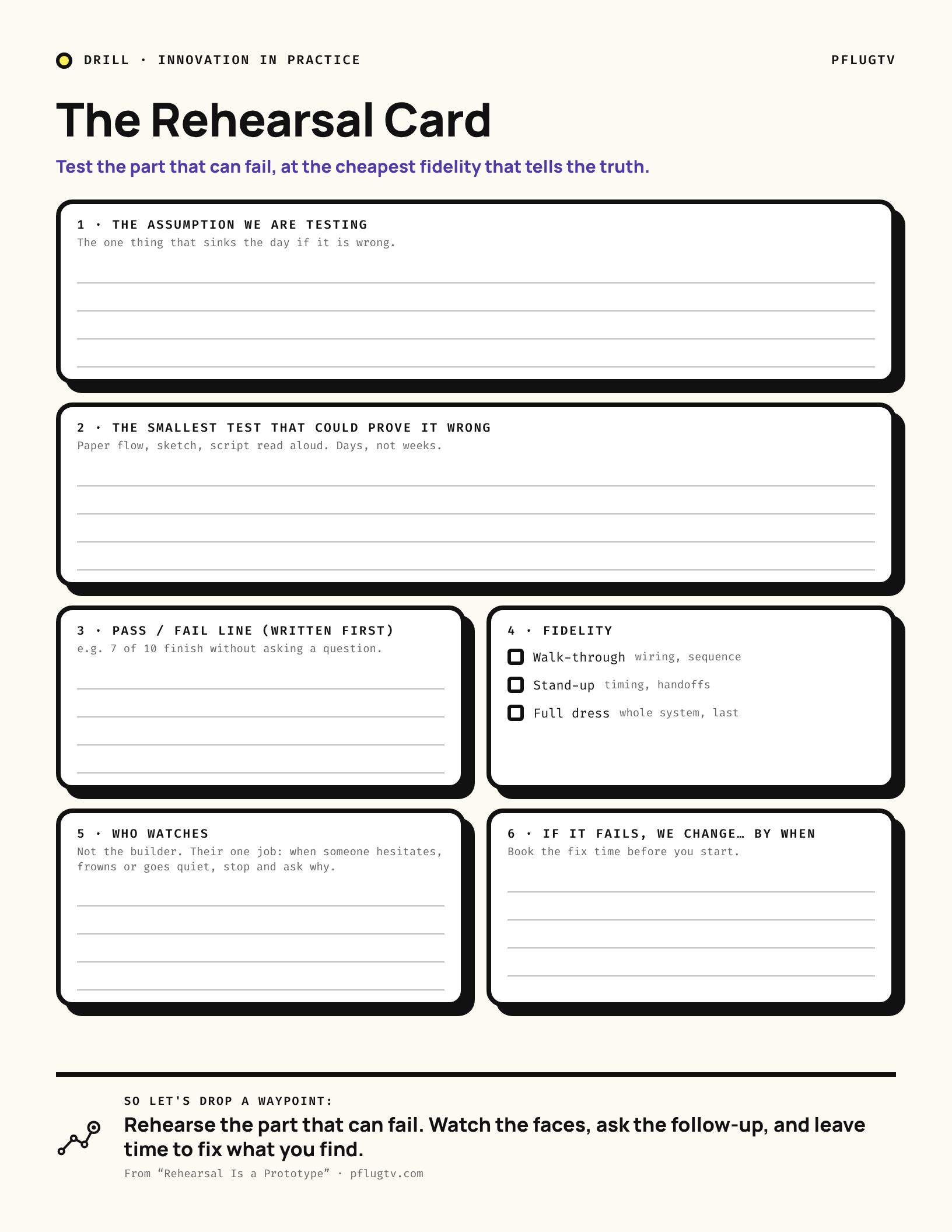
Pick one risky assumption. Not the whole product. The one thing that, if it’s wrong, sinks the day. For us it was whether the CEO could hear the room. For you it might be whether a customer can finish the task without help.
Build the smallest version that could prove it wrong. A paper flow. A clickable sketch. A script read aloud. If it takes more than a few days, it’s too big.
Write the pass/fail line before you run it. “Seven of ten people finish without asking a question.” If you set the bar after you see the result, you will find a way to pass.
Name who watches, and tell them to watch faces. Somebody has to sit at the back of the room with no job except to notice. The A2 wasn’t running a checklist item. He saw a puzzled look and asked what was wrong. In a product test, the watcher should not be the person who built the thing, and their only instruction is: when someone hesitates, frowns or goes quiet, stop and ask why.
Book the fix time before you start. The Miller fix worked because it landed before the final rehearsal, and because the answer was something we could build in the room with the gear we had. A rehearsal with no time left to change anything is just a performance.
Pick the fidelity that matches the risk
A walk-through costs almost nothing and catches wiring and sequence problems. A stand-up rehearsal catches timing and handoffs. A full dress rehearsal catches the problems only the whole system can create, and it’s expensive, so you use it last.
AI changes this in a way worth saying out loud. You can now build a convincing, high-fidelity prototype in an afternoon. That is wonderful, and it comes with a trap: the more finished a prototype looks, the less willing people are to tell you it’s wrong. Nobody wants to critique a polished thing. A rough sketch invites the honest note. A beautiful demo invites applause.
Hold that thought, because it means the cheap rehearsal matters more now, not less. Speed lets you build the dress rehearsal on day one, and tempts you to skip the walk-through that would have found the problem for free.
Try this Monday
- Name the single riskiest assumption in what you’re building right now. Write it in one sentence.
- Write the pass/fail line before you build anything to test it.
- Show the roughest version that could teach you something to three people, send a watcher whose only job is to notice hesitation, and book the time to fix what they find before your next review.

So let’s drop a waypoint: rehearse the part that can fail, at the cheapest fidelity that tells the truth. Watch the faces, ask the follow-up, and leave time to fix what you find.


Leave a Reply