
Thirty years ago I sat late at night in master control at WKOW in Madison, Wisconsin… rolling the legal ID at the top of every hour, and proud of the job. When my family asked where I worked, I gave them the call letters, because inside that building the call letters were everything. They were on the door, on the slate, and on the air every sixty minutes.
My family had no idea who I worked for.
“What channel is that on cable?”
That was the question, every single time. They didn’t know WKOW. We were channel 27 over the air, and they didn’t know that either. What they knew was a 7 on the cable box… and the 7 was NOT ours. The cable company handed it out.
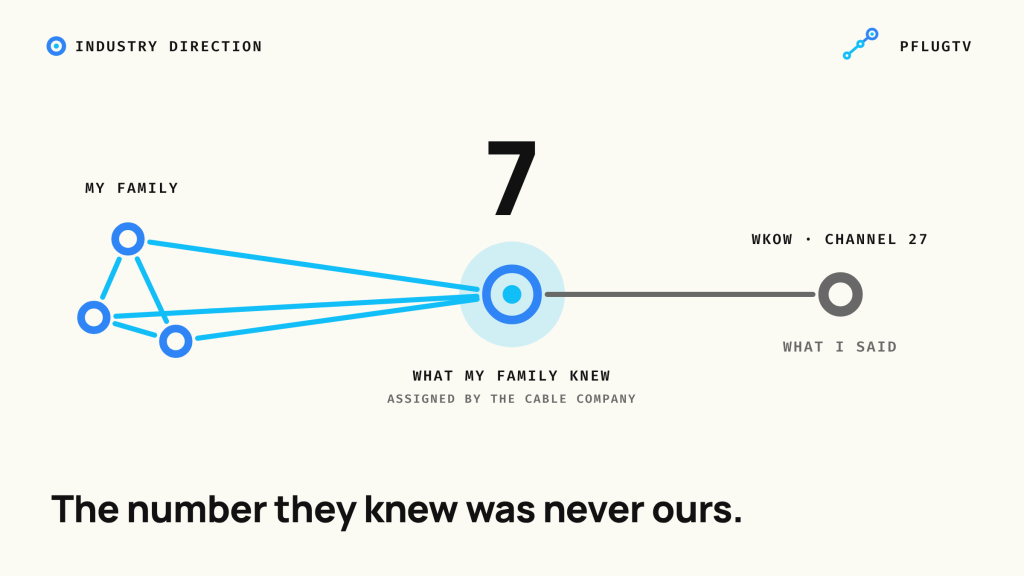
I didn’t think much of it back then. I think about it a lot these days, because that little 7 is the whole story of where our industry is headed. I call it the Channel 7 problem: your audience finds you through an address that somebody else assigned.
We never held the deed
Our industry likes to mourn “the channel” as something that streaming came along and took from us. From the master control chair, I can tell you we never had it in the first place. The station built the brand, licensed the programming, staffed the newsroom and kept the signal on the air… and the address the viewer used to find all of that hard work came from the distributor.
Nobody minded, because the 7 led to us and only us. Hold that thought, because the address has moved house twice since then.
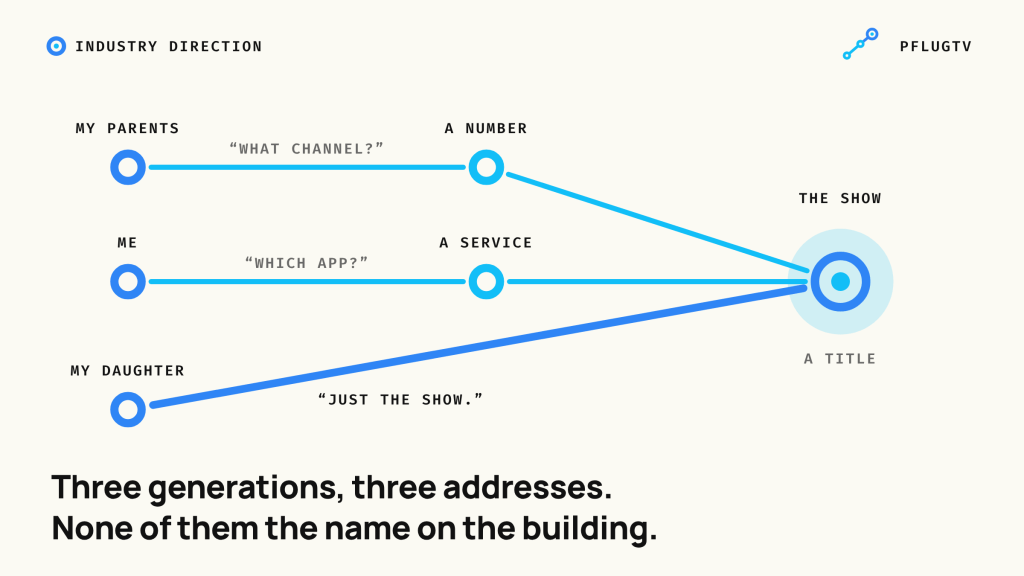
My family still asks what channel something is on, or how do I show the channel numbers on the program guide. I ask which app or service. My daughter asks neither… she holds up what she’s watching and tells me or just searched for it by program, in so many words, here’s the show, no idea who made it or what network it’s on. She’s not being careless. She is describing the product exactly the way we handed it to her.
What’s in a name?
Put that story in front of most leadership teams and the reflex is to go buy more brand… spend until the viewer remembers who made the show. I think that money is chasing the wrong thing. Hub Entertainment Research reported this month that 47% of viewers find it hard to tell what’s unique about each streaming service, up from 41% a year ago. The streamers spent a decade and a small fortune building their names, and the names are blurring anyway.
My family never learned the call letters, and it never mattered, because the address WORKED. The name was not the asset. The address was. So the question for a media company today is not “do they know who we are?” … it is WHO controls the path between wanting our show and watching it, and what are our terms with them?
That path is being repaved as I write this. Amazon redesigned Fire TV this year, and Roku retired the grid of apps that had been its home screen for thirteen years. Both now put the shows up front, pulled from every service, and both slide the apps down the page. You used to pick the service and then the show. Now you pick the show… and the platform fills in the service for you.
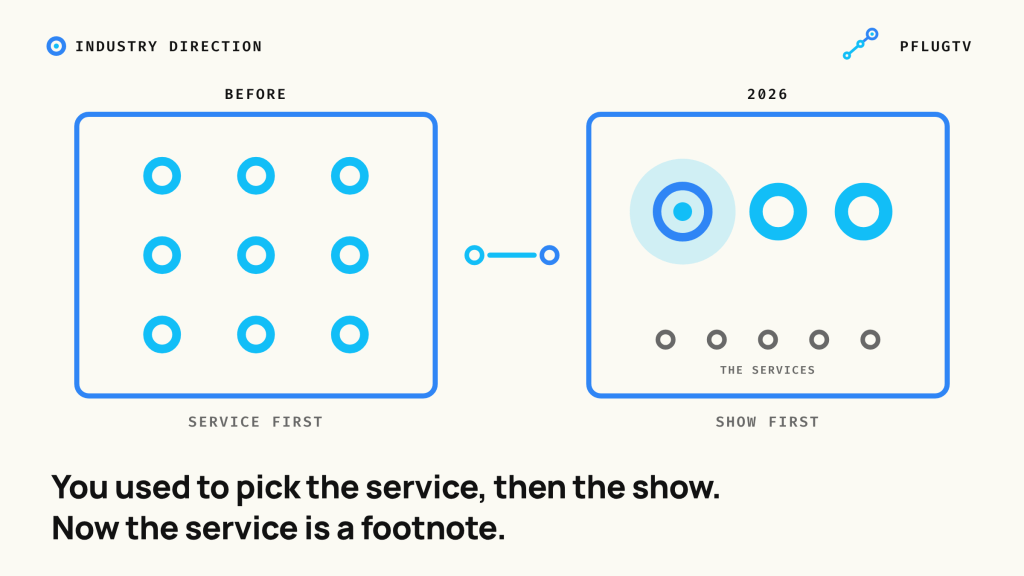
Speaking as a product guy, I can’t fault it. It is good design, and it solves a real headache for the viewer. But notice what comes along for the ride: the same show can now be served up as a subscription, a rental, or a free stream with ads, and the landlord of that screen decides which one you see first. The 7 on the cable box led to one place. A search result leads wherever the landlord would like it to.
Location, location, location
Any realtor will tell you there are only so many ways to get a good address. You buy, you rent, or you make the place so well known that people find it no matter what the street sign says. Media is no different. I see three honest plays for the Channel 7 problem, and every company in our industry is already running one of them… most just haven’t noticed which.
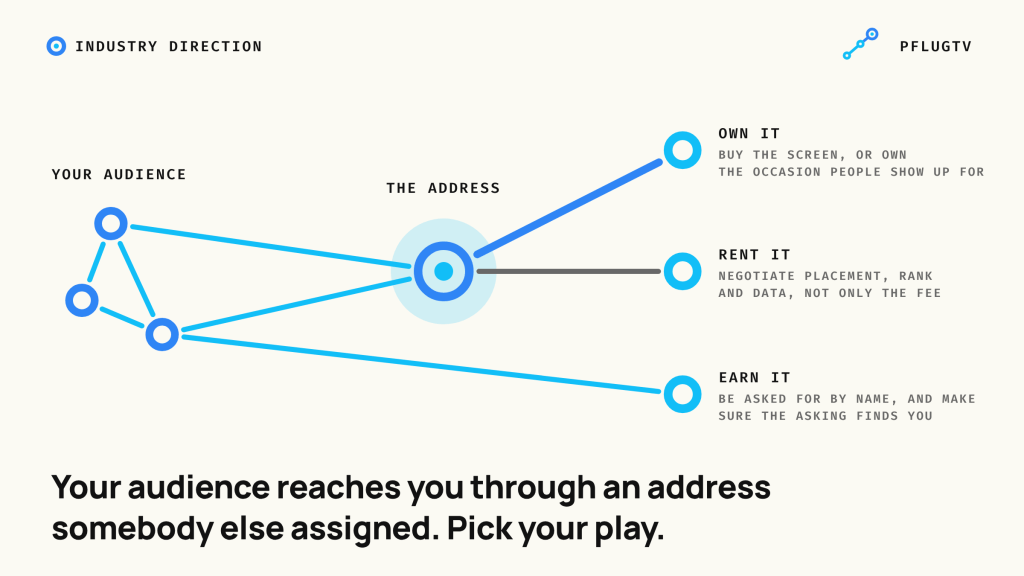
Own it. Fox just did. In November it closed on Roku, roughly $22 billion, for the home screen sitting in front of more than 100 million streaming households. A company built on local stations and cable networks did not go buy more programming… it bought the screen you see BEFORE any programming. Lachlan Murdoch reportedly called it “beachfront property.” And here is the detail I would put in front of any board. Back in 2020, Fox paid for its $440 million purchase of Tubi by selling off its 5% stake in Roku. Six years later it bought the whole house, for roughly fifty times that Tubi price. That is what it costs to decide late.
Not many of us can write that check. But owning the address does not have to mean owning a platform. It can mean owning the occasion… the game, the newscast, the night people show up without being told. I wrote years ago that LIVE is the premium, and I’ll stand by it. A viewer who arrives on purpose does not need anybody’s home screen.
Rent it… but read the lease. If you live on somebody else’s screen, the fee is no longer the main event. We need to negotiate the address itself. Where does your title land when a viewer searches for it by name? Which version is offered first, yours or the landlord’s? Does your mark travel with the tile? Do you get the viewing data back?
NBCUniversal is the one to watch. This summer it agreed to put Peacock inside YouTube Premium starting in 2027. That is an enormous amount of reach… on a screen it does not own. Whether it turns out to be a smart lease or an expensive one will come down to clauses that none of us will ever get to read.
The British understood this a long time ago. Their regulation has long guaranteed the public service broadcasters the top channel numbers in the guide, and the Media Act 2024 carries the same idea over to the home screen… designated TV platforms have to keep the public service players available, prominent and easy to reach. A regulator has decided that the position of a tile is the new channel number. I don’t expect American law to do that for any of us. So what Britain wrote into statute, a US programmer needs to write into the contract. If there is no placement clause, you are renting without a lease.
Earn it. This is the play open to everybody, and it is a product job far more than a marketing one. Be the thing people ask for by name… and then make sure the asking actually finds you. Search boxes, voice remotes and now the AI assistants do not watch your brand campaign. They read your metadata. Titles, cast, episode data, rights windows, deep links. Anybody who has sat at a replay desk knows it… the clip that nobody logged is the clip that nobody finds, no matter how good it was. Metadata is the new call letters, and too many companies still staff it like a chore for the back office.
Measure twice, cut once
A play you don’t measure is just a hope. Others have started to price the screen… Looper Insights now puts a dollar value on home-screen placement. I want the number from the other side of the glass. Call it address share: of all the times somebody starts watching your content, what percentage began on a surface you OWN, or on a placement you have under contract?
Go ask your team for that number. My bet is they can’t give it to you. They will know subscribers, hours and churn… and they will not know how the viewer came in the door. Three questions will get you most of the way. When someone finds your show, who introduced them, and what did it cost you? If your logo disappeared from the tile tomorrow, would the viewer notice anything different? And whose customer is the person watching? Not whose content… whose CUSTOMER.
Mark my words
I’ll put three predictions on the record, with dates on them, so you can hold me to it.
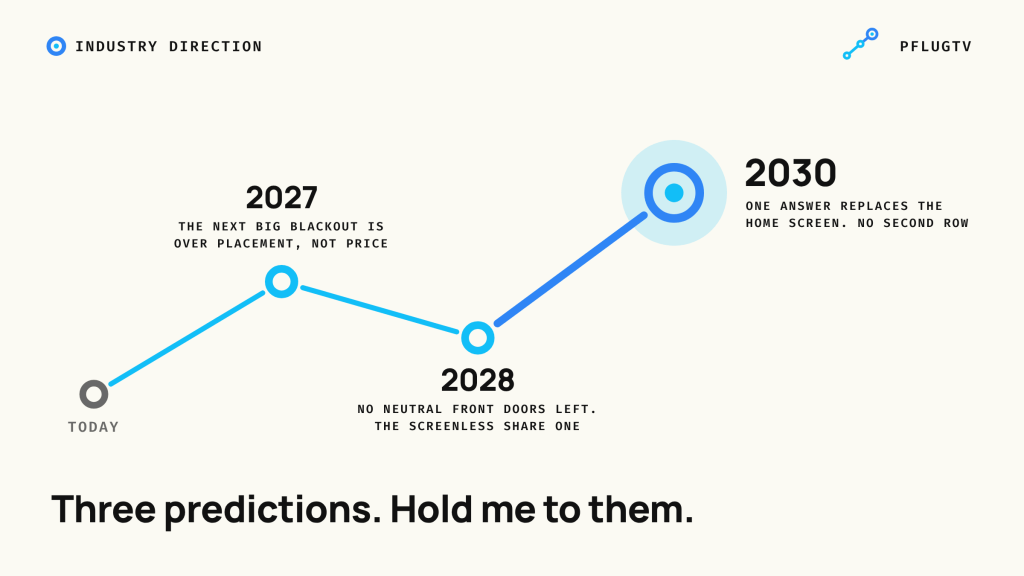
By the end of 2027, the next big blackout will be over placement and not price. Fee fights are the ones we all know how to have. But the deals are already changing shape. When Disney and YouTube TV settled in November 2025, part of the answer was folding ESPN’s streaming service into the base plan. The Peacock deal is about WHERE the content sits, not only what it costs. The first programmer to go dark over search rank or data rights is going to sound strange for about a week… and then everybody will go check their own contracts.
By 2028, there will be no neutral front doors left… and those without a screen will start sharing one. We are most of the way there. Every leading TV platform in the US already runs its own free channels right alongside yours, and the biggest of them now belongs to Fox. We need to plan as though every screen we appear on is owned by somebody who also competes with us… because it is. The programmers who can’t buy a door will build one together, the way Britain’s broadcasters did with Freely. Rivals sharing a lobby beats each of them waiting in somebody else’s.
By 2030, the answer replaces the home screen. Alexa already takes “what should I watch?” on Fire TV, and Gemini does it on Google TV. A home screen shows you forty tiles. An answer names ONE. There is no second row to be on. One early look at how the AI engines recommend streaming services found they favored depth of metadata and editorial authority over subscriber count. Read that twice. The size of the brand did not decide it… the quality of the data did.
When that day arrives, the companies that earned their address will keep it. The ones who rented without reading the lease will find out what it was worth.

Let’s drop a waypoint for our journey
The channel was never the product. It was the address… and the address has always belonged to the distributor. So own it, rent it with a lease you actually read, or earn it. Then measure which one you are doing, because not choosing is still a choice… it is just the expensive one.
My family never did learn the call letters. They found channel 7 anyway. Let’s make sure our viewers can do the same.


Leave a Reply