
Every October of an election year, the same thing happens inside a local television station. The sales floor gets quiet and a little giddy. The traffic department starts turning away paying advertisers — the car dealer, the furniture store, the regional hospital — because the inventory is gone. Every available thirty seconds between now and the first Tuesday in November has been bought by a campaign or a committee, often at a rate the car dealer could never pay.
I’ve been in those buildings. The political window is the best quarter a station has, and everybody knows it. It is also, if we’re being plain about it, the quarter where the station airs the worst product it will air all year: thirty-second packages that nobody asked for, that most viewers mute, skip, or leave the room to avoid, and that are engineered to make you trust your neighbor a little less than you did before the break.
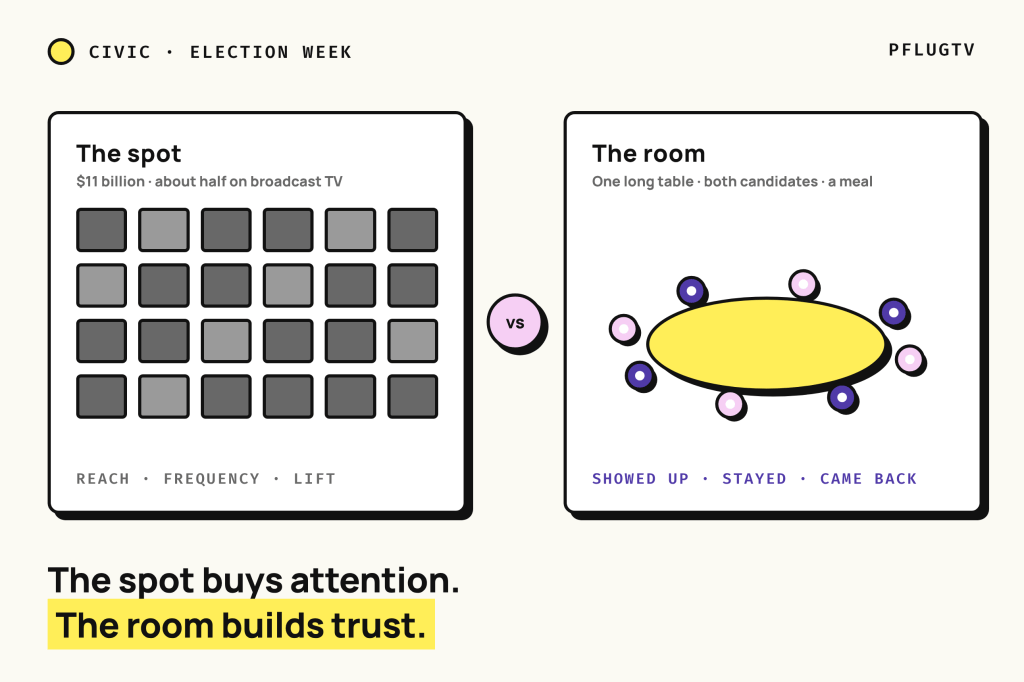
This cycle, that product cost about eleven billion dollars. Nearly half of it landed on broadcast TV. Eleven billion dollars of interruption.
The spot was never the show
Here’s something those of us in live television understands in our bones: the spot is not what people came for. People gather for the game, the ceremony, the debate, the moment that is happening right now and won’t happen again. I’ve written before that live is the moat, and I meant it in a business sense, but there’s a human truth underneath it. A live event is the one thing in media that puts a lot of strangers in the same moment at the same time.
The ad is what you sell relative to that gathering. It borrows the room’s attention. It does not build the room.
For twenty years I’ve watched the industry pour its best engineering into the live event and its best money into the interruption. We obsess over the shot, the latency, the signal path, so that fifty thousand people in a stadium and millions at home experience the same second together. Then we cut to a package that was designed, tested and targeted to make sure none of those people ever talk to each other about what they just saw.
What a room does that a feed can’t
I spent a lot of nights in arenas before the broadcast ever started, watching crowds file in. Two people in rival jerseys in the same row will argue, and then one will pass the other a napkin when the nachos spill. That is a small thing. It is also the whole thing.
Michael Smerconish calls this mingling, and he’s built a project around it: stepping out of the echo chamber and into the middle, on the theory that people who share a room come back to the basics and share a baseline. He’s drawing on Robert Putnam’s old observation that Americans stopped bowling in leagues and started bowling alone, and that the leagues were never really about bowling. They were about being near people you didn’t choose.
I follow his work because he’s describing, in civic terms, something I’ve watched for a career in production terms. The room calibrates to the people in it. A feed calibrates to the algorithm. One of those produces trust and the other produces targeting, and we have spent a generation and a staggering amount of money optimizing for the second.
Hold that thought, because this is where the two halves of my career start arguing with each other.
A flawless spot is still just an output
Measure a political ad the way a campaign measures it and it works beautifully. Reach, frequency, persuasion lift in the target demo. Every spot that airs is an output delivered on time, to spec, at scale.
Now measure it the way a product person measures anything: what changed for the people on the receiving end? Did they understand their choices better? Did they know their neighbors better? Did they feel more capable of living alongside people who voted differently on Wednesday morning?
Eleven billion dollars, and I can’t point to a single outcome on that list that improved. Several got worse. In any other product organization, a program that burned that budget to produce those results would not survive the next planning cycle. We would call it exactly what it is: an enormous volume of output pointed at the wrong thing.
Bring back the public square
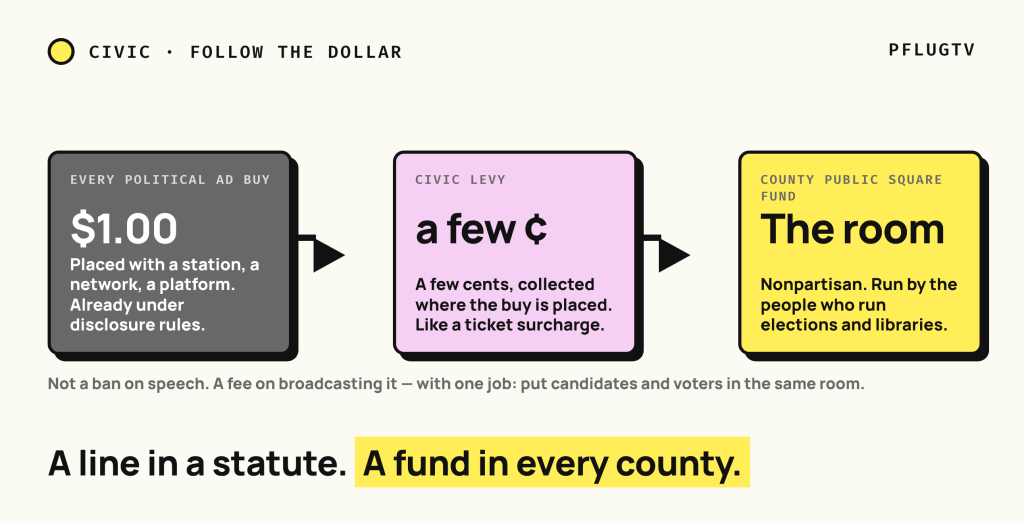
Here’s the proposal, and I’ll say it plainly: redirect a share of that money, by law, from the airwaves into the public square.
The mechanism isn’t exotic. Political ad buys already live under a set of rules — disclosure, lowest-unit-rate, sponsor identification. Add one more: a civic levy of a few cents on every political ad dollar, collected where the buy is placed, the way a ticket surcharge funds the arena. That isn’t a ban on speech. It’s a fee on broadcasting it. The money flows into a nonpartisan fund in every county, run by the people who already run elections and libraries, with one job: put candidates and voters in the same room.
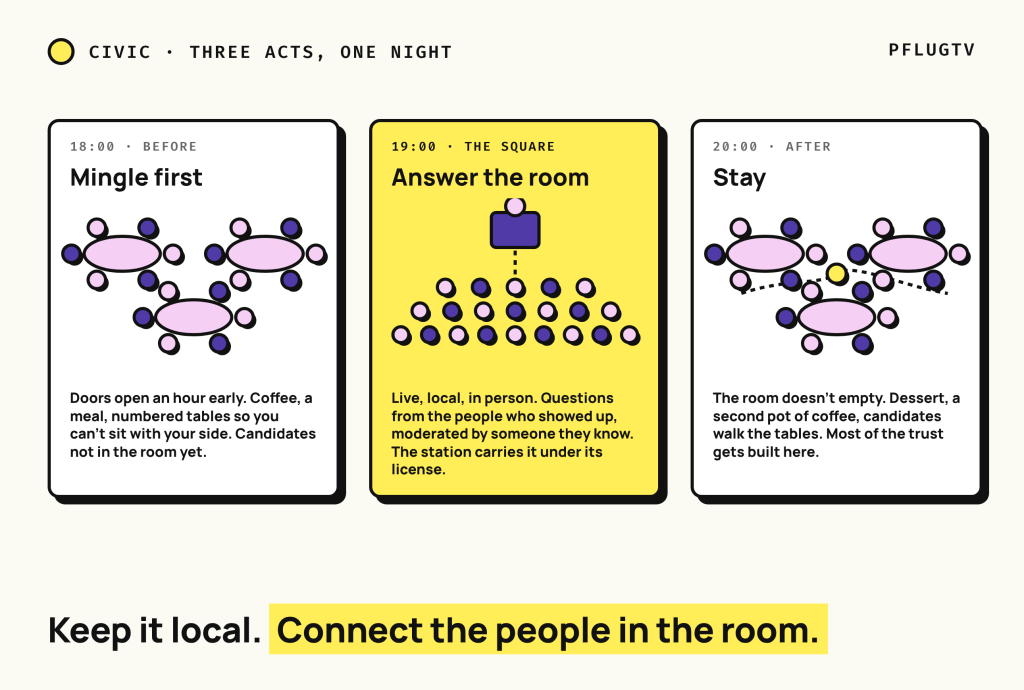
And the room has three acts, same night.
Before: mingle first. Doors open an hour early. Coffee, a meal, numbered tables so you can’t sit with your side. The candidates aren’t in the room yet. The point is that the person next to you is a neighbor before they’re a voter.
The square: candidates answer the room. Live, local, in person. The questions come from the people who showed up, moderated by someone they know — the librarian, the civics teacher, the fire chief. No packaged B-roll, no spin room. The local station carries it live under the public-interest obligation already attached to its license. The crews and the toolset are already in the building; this is some of the best programming they’ll make all year.
After: stay. The room doesn’t empty. Dessert, a second pot of coffee, and a half hour where the candidates walk the tables. Most of what builds trust happens here, not at the podium.
Keep it local. School board, county commission, state house, mayor — races where the person at the podium is someone you’ll see at the grocery store on Saturday. National spot money can’t buy that, and a local square doesn’t need it.
And measure it the way a venue measures a night: who showed up, who stayed, who came back. Reach is a vanity metric. A room is a real one.
None of this requires a constitutional amendment. It requires a line in a statute, a fund in every county, and an industry willing to point its trucks at the square instead of selling the breaks around it.
The honest objections
Town halls can be theater too; I’ve produced enough of them to know. People self-select, and the folks most likely to show up are the ones who least need to. Stations are not charities and the political window keeps a lot of local newsrooms alive. The lawyers will fight over the levy, and that’s a fight worth having in the open. All true. But every one of those is an execution problem, and execution problems are what production people solve for a living. What we have never solved, and what no amount of targeting will ever solve, is how to make strangers trust each other through a screen.

So let’s drop a waypoint: the spot buys attention, and the square builds trust, and for a generation we’ve funded the first while starving the second. Legislate a slice of the ad dollar back to the public square, put candidates in front of their neighbors, and give those neighbors an hour on either side to become neighbors again. Point the production facilities at the town square.
Nobody ever passed a napkin to a thirty-second spot.


Leave a Reply